

September 25, 2025
Key Takeaways
-
Ankle sprains are ligament damage and can cause chronic instability if neglected. Get evaluated early to avoid chronic pain, limited mobility, and re-injury.
-
Understand your sprain grade as severity directs treatment and timelines. Mild sprains tend to respond well to RICE and support. Moderate to severe sprains require more structured rehab and sometimes immobilization or surgery.
-
Begin early care with RICE, then shield the joint with a brace or crutches. Take OTC pain medication as prescribed and introduce light movement within pain limits to prevent stiffness.
-
Construct healing with advanced physiotherapy that rebuilds strength, balance, and range of motion. Add proprioception and balance exercises to minimize future sprains and monitor milestones to fine-tune your plan as you recover.
-
Once in a while, consider advanced treatments like manual, laser, or electrical stimulation as appropriate. Follow clinician-guided programs to customize treatment to your activity level and recovery goals.
-
In Edmonton, registered physiotherapists and specialized clinics provide accurate diagnosis, comprehensive rehab, and prevention strategies. Seek expert evaluation to rule out fractures, tailor care, and return to activity safely.
Ankle sprain treatment Edmonton – fast evaluation, RICE care in the first 24 to 48 hours, and supervised rehab with a physio. Mild sprains usually mend in 2 to 4 weeks with rest, ice, compression wraps, and elevation, as well as range-of-motion exercises once the pain subsides. Moderate sprains might require a lace-up brace or walking boot for short-term stability, then strength and balance exercises to reduce the risk of recurrent sprains. Severe sprains associated with shooting pain, swelling, or difficulty bearing weight may warrant imaging and referral to sports medicine. Edmonton clinics provide same-day physio, manual therapy, ultrasound or laser, and return-to-sport plans. In selecting treatment, considerations encompass clinic availability, price, rehab schedules, and at-home exercise assistance described below.
More Than "Just a Sprain"
An ankle sprain is ligament damage. Not “just a sprain.” Ligaments are “strong bands holding bones together.” When they tear or overstretch, the joint loses support, swells, and hurts with load. It’s more than “just a sprain.” Without care, the joint can heal loose. That lays the foundation for chronic ankle instability, repeat sprains, and pain with daily use.
High ankle sprain, or syndesmosis injury, affects the ligaments that connect the tibia and fibula above the ankle. It can be worse than an average lateral sprain. It frequently results from a sudden twist, an aggressive eversion, a direct impact, or the foot turning outward as the leg turns inward. It takes eight weeks to six months to heal and those first few days won’t look dramatic. Typical ankle x-rays can appear normal. A careful exam, squeeze tests, weight-bearing views, or advanced imaging might be required. When neglected or poorly treated, this injury leads to long-term pain, laxity, and recurrent sprains.
Sprains untreated do in fact change the way you move. Even easy things like walking 1 to 2 kilometers, taking stairs downhill, or standing at work feel shaky and sore. Or you could simply avoid bending the ankle, which displaces load to the knee or hip. In sports, push-off, cutting, and landings lose sting and control. For runners, side-to-side trails or sudden stops increase the likelihood of a setback. For field and court sports, late-game fatigue and a weak ankle lead to another sprain. Eventually, bad joint control will increase wear on the cartilage and tendons around the foot and ankle.
Early care does help stop that slide. The objective is to first soothe pain and guard tissue, and then restore strength and balance. For high ankle sprains, phase one might require a boot or cast and crutches to remain non-weight bearing. Phase two introduces range of motion, light load, and steady strength to the calf, peroneals, and core. Phase three shifts to sport tasks: hops, cuts, change of pace, and reactive drills. Benchmarks guide each step: pain less than three out of ten with weight, near-equal range, and single-leg balance for at least thirty to forty-five seconds. These four steps reduce the risk of a re-sprain and stabilize your daily life.
What Is Your Sprain Grade?
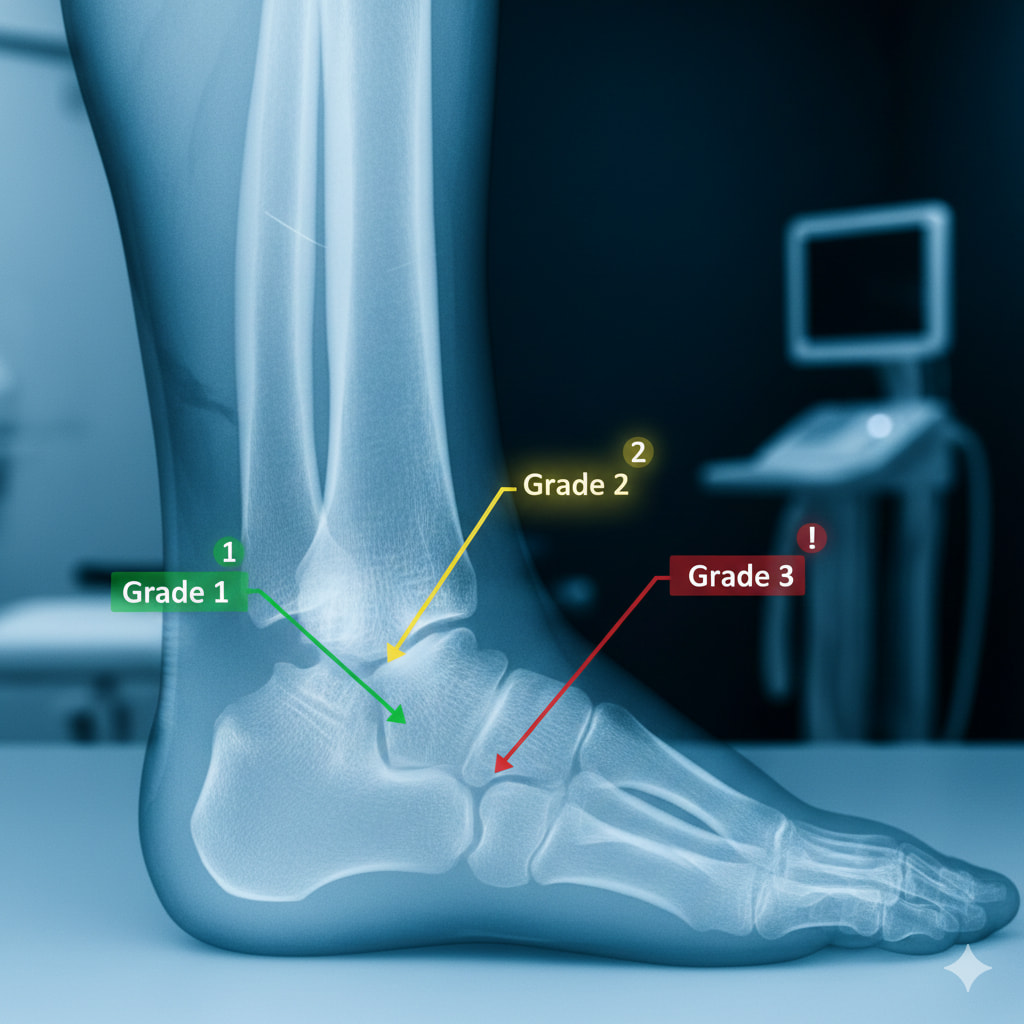
Grading tells how much damage your ankle ligaments received. It determines your symptoms, care regimen, and how long you’ll be sidelined. Proper grading informs decisions such as bracing, imaging, rehab, and return to sports or work.
|
Sprain grade |
Typical symptoms |
First steps |
Expected recovery |
|---|---|---|---|
|
Grade 1 (mild) |
Light swelling, mild pain, stable joint, near-normal walk |
RICE: rest, ice 20–30 min up to 4×/day, compression, elevation |
About 2–3 weeks |
|
Grade 2 (moderate) |
Noticeable swelling, bruising, sharper pain, hard to bear weight |
RICE, brace, crutches as needed, start physio within days |
About 4–6 weeks |
|
Grade 3 (severe) |
Marked swelling, intense pain, clear instability, possible pop |
Boot or cast, medical review, structured rehab; sometimes surgery |
12+ weeks |
Correct grade is important because it establishes the load you can tolerate, protects against reinjury, and chronic ankle instability.
1. Mild Sprain
A mild sprain means ligament fibers are stretched with microscopic tears. The joint remains stable.
You might observe mild swelling and experience tenderness on the lateral ankle. You can stand and ambulate with minimal alteration to your gait. Stiffness appears in the morning or after sitting.
Begin with RICE. Rest for 24-48 hours, ice for 20-30 minutes up to 4 times a day, use a snug elastic wrap, and keep the ankle elevated above the heart. Short walks on flat ground are okay if pain is low.
Back to activity over days. An ankle brace or stiff shoes can assist while running errands, shuffling from your desk to the door, or hitting the gym lightly.
2. Moderate Sprain
A moderate sprain includes a partial ligament tear. Swelling is clearer and bruising often tracks down along the foot.
Pain increases with weight bearing, stairs, or side-to-side movements. Many people limp and refuse to push off.
Expect RICE and a plan. Early physio introduces range-of-motion drills, then band work, balance tasks, and gait training. Crutches might assist for a few days to contain pain. The goal is to regain strength, proprioception, and ankle control to reduce re-sprain risk.
3. Severe Sprain
A serious sprain indicates a full tear in one or more ligaments, with obvious swelling and intense pain. The ankle feels unstable and you may have felt a pop.
Immobilization with a boot or cast is typical for that and a few weeks. Prepare for 12 or more weeks of recovery, including up to 12 weeks of therapy.
Be on guard for associated problems such as fractures or cartilage damage. Surgical repair may be warranted with persistent instability, high-level sport demands, or failed rehabilitation. Improper care can lead to long term instability.
The Chronic Instability Trap
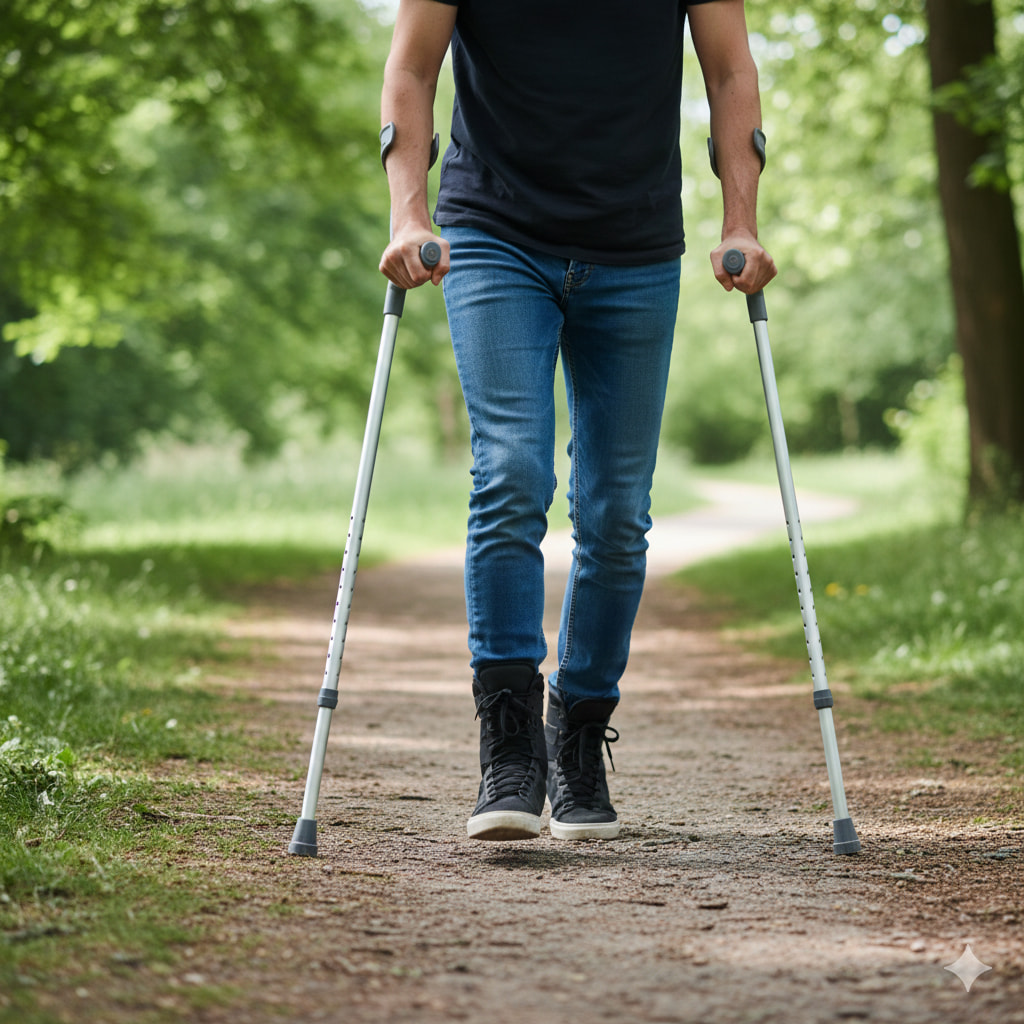
Chronic ankle instability is the usual consequence of recurring sprains or hasty rehab. It manifests when the ligaments, tendons, and joint sensors don’t communicate in harmony, so the ankle continues giving out during everyday activities, athletic competition, or uneven terrain. In Edmonton, treatment plans aim to stop this pattern early, but the same ideas apply anywhere: protect tissue, restore control, and build strength that lasts.
Repeated sprains begin with skipped steps in rehab. Once the swelling goes down, most of us walk and jog too early, or we just rest. Without directed range-of-motion exercises, balance work, and load-specific strength, the peronees and deep stabilizers fall behind. Scar tissue stiffens some portions of the capsule while other areas remain lax. The consequence is a joint that seems repaired but does not respond quickly when the foot shifts. A common example is being pain-free in a straight line, but the ankle rolls when stepping off a curb or cutting on turf.
Common symptoms are easy rolling with low-impact maneuvers, a sensation of ‘loose’ or ‘wobbly’ support and a throbbing outer ankle that intensifies post long walks. Others experience clicking, catching, or swelling after brief periods of play. Morning stiffness that resolves in 10 to 15 minutes is frequent. Weak one-legged stance beyond 20 to 30 seconds, difficulty holding a single-leg calf raise, and poor control on a wobble board all indicate deficiencies in stability.
Left unchecked, chronic instability increases your risk for new sprains and joint degeneration. Every sprain can chip at cartilage and stress the subtalar joint. Gradually, this may accelerate degenerative changes and alter gait, which in turn agitates the knee, hip, and low back. Runners could experience slower splits and additional off-days. Field athletes frequently cut training volume to sidestep flare-ups, which stagnates advancement.
Sticking to a comprehensive plan disrupts the pattern. Essential steps are progressive peroneal, calf, and glute strength, daily balance work on firm and unstable surfaces with eyes open and closed, hopping and change of direction drills when pain permits, and external support such as taping or a lace-up brace with high-risk activities. Employ graded loads, two to three sessions per week, and measure progress by seconds on one-leg holds. Get care if pain, swelling, or giving way continues beyond two to three weeks, or if night pain or numbness emerges.
Ankle Sprain Treatment Edmonton
Edmonton provides you access to registered physiotherapists and sports medicine teams who customize ankle sprain treatment to injury severity and lifestyle. We’ll give you the accurate diagnosis, focused rehab and prevention plans that empower you to return to your life, your work or your sport faster and safer.
Initial Care
-
Stop activity and assess weight bearing. If you cannot take four steps, seek urgent care to rule out fracture or severe ligament damage. Severe sprains are not minor and may need prompt imaging. In children, an X-ray may be needed to check the growth plate.
-
RICE within the first 48 to 72 hours: Rest to protect tissue. Ice for 15 to 20 minutes every 2 to 3 hours. Wear a tight elastic wrap most of the time for compression. Elevate the ankle above heart level for 2 to 3 hours a day to reduce swelling.
-
Offload as needed: Use a lace-up brace, semi-rigid stirrup, crutches, or a hiking boot to cut load and protect ligaments. A brace can keep the Achilles flexible while it heals.
-
Pain and inflammation control: Over-the-counter ibuprofen or acetaminophen can ease pain. Follow label directions and consult a doctor.
-
Early movement: Begin gentle, pain-free ankle pumps, alphabet tracing and toe curls within tolerance to maintain joint motion and cut stiffness.
Healing timelines vary: mild takes 1 to 3 weeks, moderate takes 3 to 6 weeks, and severe takes several months. Plan work and sport with this in mind.
Advanced Therapies
Manual therapy can decrease stiffness, restore glide and reduce pain. They employ joint mobilizations for talocrural and subtalar joints and soft tissue work on peroneals, calves and plantar fascia to help healing and flexibility.
Laser therapy and electrical stimulation can assist with pain and swelling in the initial stages. Every response is different, so therapists tailor modalities to symptoms and goals.
Physiotherapy programs build function. Start with range-of-motion drills, then add resisted band work for evertors and dorsiflexors. Advance to balance and proprioception through single-leg stands, wobble board work, and hop-to-stabilize exercises to reduce re-sprain risk. Solutions are tailored to sport or occupational requirements, be it trail running, warehouse shifts, or everyday walks.
Surgical Options
|
Procedure type |
Description |
Typical use |
|---|---|---|
|
Primary ligament repair |
Suture of torn ligament ends |
Acute severe rupture with instability |
|
Reconstruction (e.g., Broström) |
Reinforcement/augmentation using native tissue or graft |
Chronic instability or failed rehab |
|
Fracture fixation |
Screws/plates for associated breaks |
Avulsion or malleolar fractures |
May involve ligament repair or reconstruction and associated bone fractures. After surgery, rehab is needed to regain your complete range of motion, strength, and balance. Follow a structured plan: protected weight bearing, range-of-motion milestones, progressive loading, then return to run and change of direction drills. Start rehab early to avoid stiffness and supervised exercises reduce the chances of re-injury.
Your Recovery Blueprint
Your Recovery Blueprint – A clear plan connects clinic care with your home work. Timelines vary: mild sprains often heal in 1 to 3 weeks, moderate in 3 to 6 weeks, and severe tears can take months. Measure milestones, review each week, and tweak.
-
First 72 hours: Rest, protect, and control swelling. Ice for 15 to 20 minutes every few hours for 48 to 72 hours. Apply compression, keep it elevated higher than your heart, and walk just as far as the pain lets you.
-
Early activation (days 3–10): Start pain-free range of motion. Trace ABC’s with toes. Add ankle opposition isometrics. Sit tall and push the foot gently into your hand in four directions for 6 seconds and do 6–8 reps.
-
Strength and balance (week 2+): Add banded plantarflexion, dorsiflexion, inversion, and eversion. Start single-leg balance on a flat floor, arms out, raise the good leg; hold for 20 to 30 seconds. Advance to something soft, like a pillow or foam.
-
Proprioception and agility (weeks 3–6+): Use a balance board, lateral step-overs, mini hops, then controlled change of direction drills.
-
Return to sport or work: pass a checklist that includes pain less than or equal to 2 out of 10, no swelling the next day, equal single-leg balance of 30 seconds or more, near-equal calf raises, and hop tests within 90 percent of the other side.
-
Ongoing assessment: Review progress each week. If pain spikes or swelling lingers, scale back and re-test.
-
Structured care: schedule physiotherapy for manual therapy, swelling control, and graded loading. Mirror clinic, work from home 3-5 days per week.
Rehabilitation
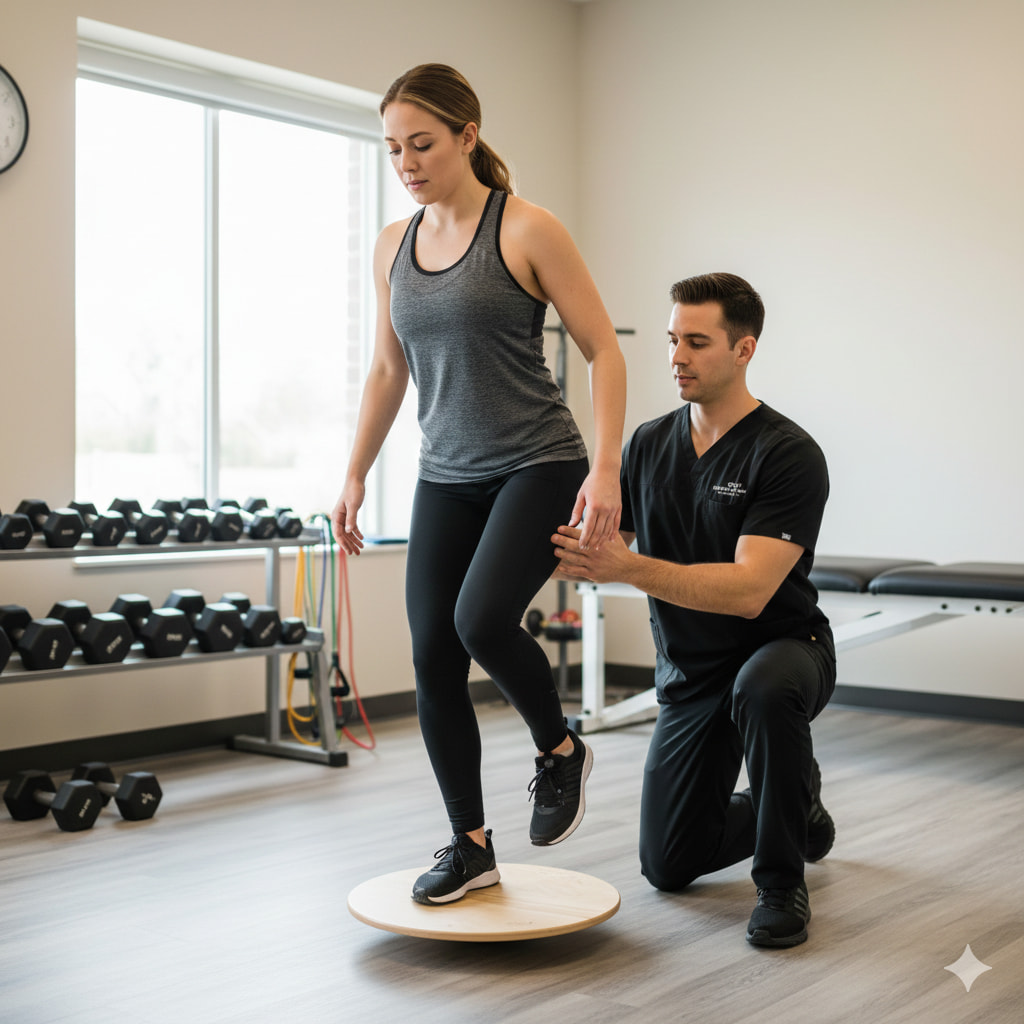
Aim for strength, flexibility and balance with a gradual incline. Early on, aim for full, pain-free range: ankle circles, towel stretches for the calf, and gentle dorsiflexion lunges against a wall. Include bands for two to three sets of twelve to fifteen reps. Work it slow and controlled, not fast.
Balance training is important for stability. Begin single-leg stance on the floor, then with eyes closed, then on a foam pad. Your Recovery Blueprint includes a wobble board for tilts, clock-reach taps, and partner perturbations. Advance only if form remains for 30 to 45 seconds without wobble.
Add load incrementally. Progress from double-leg to single-leg calf raises, to small hops in place, to lateral hops. Keep a log of reps, surfaces, and next-day symptoms. Weekly physiotherapy can fine-tune form, get stiff joints moving, and advise when to push drills forward or take a break.
Prevention
-
Wear well‑fitting shoes with good lateral support
-
Warm up for 5 to 10 minutes, cool down, and stretch calves and peroneals.
-
Tape or brace for high‑risk sports or uneven terrain
-
Keep training logs to spot sudden spikes in load
-
Train both ankles; asymmetry raises risk
INCLUDE ANKLE WORK IN NORMAL DAYS Perform calf raises, band work, and towel stretches 2 to 3 times weekly.
Add balance drills year-round: single-leg stance while brushing teeth, foam holds, and board work. These eliminated repeat sprains and chronic laxity.
Monitor training load. No sudden increases in mileage, jump counts or intensity. About Your Recovery Blueprint Stay Clean Learn and maintain clean landing and cutting technique under fatigue.
Why Expert Diagnosis Is Crucial
Proper diagnosis guides safe recovery. A lot of ankle sprains are common, but they’re not always minor. The initial task is to differentiate a sprain from a fracture, bone bruise or tendon damage. Pain, swelling, and loss of motion are indistinguishable in many ankle problems. Without a call like this, treatment can miss the mark and stymie healing.
Experienced clinicians start with a full history and hands-on exam. They check where it hurts, test ligament stability, and look for red flags like bone tenderness or numbness. They sort out low ankle sprains from high ankle sprains, which are syndesmotic injuries. This matters because a high ankle sprain often needs more protection and can take 12 weeks or more to heal. In kids, X-rays help spot growth plate injuries near the ankle, which change the plan and follow-up.
Imaging bolsters the exam when necessary. X‑rays eliminate fracture, joint space, and growth plate injury. Ultrasound can demonstrate a torn ligament or tendon dynamically in real time during a stress test. MRI maps the precise ligament injured, whether it is the ATFL, CFL, or the syndesmosis, and looks for cartilage and bone edema. This depth of specificity directs the brace type, weight‑bearing restrictions, and the correct rehabilitation steps. It clears out look‑alike issues like Achilles tendinitis, peroneal tendon tears, osteochondral lesions, tendonitis, or early osteoarthritis, all with a different route to recovery.
A correct diagnosis yields a plan that matches the injury and the individual. In a mild lateral sprain, care might be centered on early weight bearing, range-of-motion drills, and balance work. For a high ankle sprain, the plan might consist of a boot, delayed loading, and later-stage strength and return-to-sport testing. If imaging reveals a fracture or other significant instability, surgery could be the safer course. It leads to faster, safer healing with less chance of re-sprain, lasting pain, or permanent joint damage.
For my readers out in Edmonton, expert care at Edmonton Foot Clinic provides this level of evaluation and therapy. You’ll get definitive triage, precise imaging, and a rehab roadmap along with advice on sport or work return timelines in metres walked, stairs climbed, and load carried. Even when an ankle sprain sounds small, that expert review prevents missed injuries and sets the ankle up to stay strong.
Conclusion
An ankle sprain can rebound beautifully with the proper plan. Immediate care helps reduce pain and swelling. A definitive grade informs load and pace. Tough ankles require more than rest. Good rehab develops range, strength, and balance. That reduces the risk of a recurrent sprain.
Ankle sprain treatment edmonton close and fast to book in Edmonton. A physio can conduct tests, identify warning signs, and establish a treatment plan that is appropriate for your sport, occupation, and schedule. Basic exercises such as calf raises, single-leg stands, and step work restore confidence in the joint. Tiny victories pile up week after week.
So, ready to sort your next step? Call a clinic, inquire into same-week openings, and bring your ambitions. Take it light today and walk easier next week.
Frequently Asked Questions
How do I know if my ankle sprain needs medical care?
Visit a clinician with severe pain, swelling, bruising, weight bearing difficulty or a popping sound upon injury. Numbness, deformity or pain that persists more than 48 hours should be evaluated. Initial evaluation avoids overlooked fractures and chronic instability.
What are the grades of an ankle sprain?
-
Grade I: Mild stretch, minimal swelling, stable joint.
-
Grade II: Partial ligament tear, moderate swelling, painful weight bearing.
-
Grade III: Complete tear, major swelling, instability, and often cannot bear weight. A clinician verifies the grade and directs treatment.
What is the risk of chronic ankle instability after a sprain?
As many as 40% can develop chronic pain, weakness, or recurrent sprains if rehab is insufficient. Proper diagnosis, progressive strengthening, balance training, and bracing reduce this risk. It’s early, structured care that matters most.
What treatments are offered for ankle sprains in Edmonton?
Expect personalized care: accurate diagnosis, swelling control, protected loading, range-of-motion work, strength and balance training, sport-specific drills, and return-to-activity planning. Bracing or taping can assist. Severe cases might require imaging or specialist referral.
How long does recovery usually take?
-
Grade I: 1–2 weeks
-
Grade II: 3–6 weeks
-
Grade III: 8 to 12 weeks. Timelines depend on age, activity, and compliance with rehab. Tracked and tuned to your goals.
When can I return to sport or work?
Come back when pain is minimal, swelling is managed, range of motion is almost normal, symmetrical strength is present, and you pass balance tests. A clinician should clear you and can recommend bracing during early return.
Why is expert diagnosis crucial for ankle sprains?
Specialists exclude fractures, high-ankle sprains, and tendon injuries. They grade the sprain, target the appropriate tissues, and develop a safe, progressive plan. This quickens recovery and minimizes re-injury and chronic instability.
Tiny toes, big adventures! Explore podiatric services at Edmonton’s trusted foot clinic.
You might also want to check these resources for additional information: