September 09, 2026
Custom Orthotics for Standing: A Practical Guide
Key Takeaways
-
Standing all day on hard surfaces, as is the case in nursing, trades, and retail positions, wreaks havoc on your feet and joints, causing issues such as heel and arch pain and overall fatigue. By recognizing these early signs, readers can seek support before issues become chronic.
-
Localized pressure at the heel, ball of the foot and arches, which increases with thin insoles and unsupportive footwear, can cause calluses, corns and forefoot conditions. Selecting supportive shoes and orthotic insoles helps shift pressure and minimizes these problem zones.
-
Muscle fatigue in the feet, calves, and legs diminishes your natural shock absorption and increases the likelihood of persistent pain and injury. My readers swear by their custom orthotics, combined with frequent movement breaks and stretching to survive extended standing.
-
Custom orthotics offer specific support, pressure redistribution, and biomechanical correction that off-the-shelf inserts seldom compete with, particularly for flat feet, high arches, or plantar fasciitis. They’re a no-brainer for anyone dealing with chronic pain, abnormal foot anatomy, or a physically taxing job.
-
Through a thorough clinical evaluation that includes gait analysis, pressure mapping and material selection, we can ensure that your orthotics is perfectly matched to your foot mechanics, activity level and work environment. Getting ready for this procedure by jotting down symptoms, daily activities and shoe preferences assists in ensuring optimal results.
-
Pairing custom orthotics with daily life is most effective when combined with appropriate shoes, rotating shoes regularly, desk-friendly exercises, and monitoring discomfort over time. By monitoring their symptoms and seeking foot care professionals when pain lingers, readers can safeguard their feet, joints, and mobility.
Custom orthotics for standing are shoe inserts tailored to an individual’s foot anatomy and support requirements, designed to alleviate pressure during extended periods of standing. They redistribute pressure and add sturdy arch support. They can relieve common pains like heel pain, sore arches, or fatigued legs after a long day. Individuals who stand on hard floors — from retail workers to healthcare professionals to factory laborers — sometimes swear by custom orthotics to maintain better posture and reduce daily pain. From soft foam to rigid plastic, materials are chosen depending on body weight, foot type, and work requirements. The following sections explain types, benefits, and how fitting works.
Prolonged Standing Effects

Extended standing piles load onto feet, lower limbs, and spine in a manner the body doesn’t tolerate gracefully. Nurses on 10 to 12 hour shifts, retail workers pounding sales floors, or tradesmen on concrete sites all commonly experience heel pain, arch fatigue, calf tightness, and dull soreness that persists into the night and can interfere with sleep. Hard floors, thin soles, and flattened-out cushioning amplify ground reaction forces, so every second in the stand presses down on the same places of the foot instead of allowing pressure to dissipate like it does during walking. This slow, cyclical loading can lay the groundwork for issues such as plantar fasciitis, shin splints, and tendonitis, particularly when shoes are missing arch support or a good fit.
When standing constitutes the bulk of the work, strain is more than a comfort concern. Chronic stress to the plantar fascia, Achilles tendon, and the small intrinsic foot muscles alters how a person stands and walks. They start to lean on one side, lock their knees, or claw the ground with their toes, which then contributes to joint stress up the chain. Over years, this constant overload on feet and legs can cause damage and long-term health effects that are less easy to reverse, rather than short-term aches that subside with rest.
Custom orthotics and supportive insoles seek to alter the way this load is delivered to the body. By molding the foot-shoe interface, they assist in distributing pressure more uniformly, direct the foot into a more neutral posture, and provide strained tissues an opportunity to perform less with each move. For many standing workers, this strategy pairs with other moves—better shoes, short walking breaks and easy stretches—as a hands-on method to reduce daily stress rather than just managing pain once it gets chronic.
Pressure Points
During long hours of standing, three main zones usually take most of the load: the heel, the ball of the foot, and the arches. On hard floors, the heel behaves like the initial contact and absorbs a high proportion of impact. The forefoot then bears weight when a person reaches forward, bends, or moves. The arches are suspended in between, attempting to maintain the foot’s form as body weight pushes down from above and the floor holds up against it from below.
For additional educational information about plantar fascia-related heel pain, readers can review this Alberta Health Services plantar fasciitis resource.
Thin insoles, safety boots with stiff midsoles and fashion shoes with narrow toe boxes often exacerbate these high-pressure spots. A cashier who stands nearly motionless at a counter may have burning under the ball of her foot by mid-shift, while a lab worker in flat, unsupportive sneakers may get a stabbing pain in the heel every time she turns or pivots. When the insole doesn’t fit the shape of your arch, pressure pools in tiny pockets rather than dispersing over your entire foot.
Over time, this additional burden on concentrated areas can cause calluses, corns, and even metatarsalgia, a condition in which the ball of the foot, the area beneath the metatarsal heads, becomes sore and inflamed. These are not just cosmetic changes; they are indications the skin and deeper tissues are doing their best to manage chronic strain. Once these pressure points form, pain can surface even during short walks or while standing in line outside of work.
Custom orthotics or well‑designed orthotic insoles attempt to ‘even out the pressure mountains’ by cupping the heel, supporting the arch, and providing the forefoot with a flatter foundation. For instance, a nurse on a tile ward could benefit from orthotics that have a deep heel cup and metatarsal pad to disperse load away from a sensitive heel and overburdened forefoot. This reshuffling can relieve symptoms and reduce the risk that minor issues turn into chronic injuries.
Muscle Fatigue
Standing still for hours exhausts the micro-muscles of the feet and the larger groups in the calves and thighs. These muscles engage constantly to maintain the body in an upright position, even without any significant motion. When they don’t get regular breaks through walking or sitting, they fatigue, lose some of their fine control, and start to shake or tighten.
As muscle fatigue accumulates, the foot’s innate shock absorption decreases. The arches begin to sag, and the heel pad doesn’t absorb bounce as much, so more impact lands on joints and ligaments with every move. This is why individuals who stand all day long can suffer from chronic aches including arch fatigue, tight calves, and aching shins similar to shin splints or tendonitis. The pain may linger into the evening, making it more difficult to unwind and fall asleep.
Supportive insoles or custom orthotics can reduce muscle overuse by distributing some of the labor that exhausted muscles are attempting to do on their own. A factory worker, for example, could use an orthotic with solid arch support and moderate heel lift, which gives the calf and plantar fascia less wear and tear every hour. Long term, this can build endurance, so that the very same shift starts to feel less exhausting on your legs and feet.
To maintain fatigue lower through the day, short, regular movement breaks play a role. Basic habits such as walking a small loop every 45 to 60 minutes, rocking heel to toe instead of locking the knees, and quick calf and foot stretches during downtime can assist. Even micro-variations in stance such as weight-shifting from foot to foot or to a footrest lessen the duration that any one muscle group maintains the same load.
Joint Stress
Standing for long stretches doesn’t just affect soft tissues. It loads joints in the ankles, knees, hips, and lower back. When you stand stationary on solid ground, these joints are stacked hinges beneath an unyielding vertical load, with minimal opportunity to reset via the shifting movements of ambulation. Over months and years, this consistent strain can accelerate wear in joint surfaces and supporting structures.
Bad foot alignment and weak shoe support usually compound this issue. If the feet roll inward, which is known as overpronation, or outward, or if one leg carries more weight, the knees and hips have to rotate a bit to regain balance. Even a chef on a concrete kitchen floor in flat, worn shoes can begin the day in an aligned neutral posture but slip into a more collapsed stance by the close of service. This shift alters the way forces travel through the joints and potentially contributes to knee and low back pain post-work.
We sometimes use custom orthotics to help direct the foot to a more neutral line, so the ankle, knee, and hip can stack more evenly. By realigning how the heel and arch strike the ground, orthotics reduce abnormal lateral forces on the joints and can help mitigate cumulative stress that may play a role in premature joint deterioration. For individuals already experiencing daily joint soreness from standing, this improved alignment can be one piece of a larger strategy that might involve improved shoes, strength work, and scheduled rest.
Neglecting joint stress induced by long-term standing enables small problems to snowball into bigger issues, including chronic injuries and occasionally arthritis in load-bearing joints.
Custom Orthotics for Standing

Custom orthotics are prescription medical devices constructed from a thorough analysis of foot shape, gait and loading patterns. These aren’t your basic insoles; they’re mapped to the movement of each foot, not a shoe size. For all-day standers, they’re often prescribed to ease pain, promote better alignment, and reduce repetitive strain that can cause chronic foot and leg issues.
Sure, store-bought inserts will give you some plush cushioning, but they’re typically crafted from low-grade foam that flattens quickly. They provide general support and not targeted correction, so they frequently come up short for flat feet, high arches, heel spurs or plantar fasciitis. Custom devices are made from higher-quality materials that may last one to three years based on wear time, activity level, and care, allowing them to be more durable over the long term.
Custom orthotics can be sculpted to offload sore spots, like the heel in plantar fasciitis or the ball of the foot in metatarsalgia and Morton’s neuroma. They address structural patterns such as flat feet and high arches, where the goal is not to ‘correct’ the foot but to distribute pressure more evenly and reduce stress on tissue and joints. Since the results are contingent on foot structure, footwear, and the actual source of pain, a thorough consultation is generally necessary before initiating.
Key benefits of custom orthotics for standing include:
-
More even pressure spread across the whole foot
-
Improved alignment from feet to ankles, knees, hips, and all the way up the spine.
-
Less repeat strain can cause plantar fasciitis, shin splints, and tendonitis.
-
Reduced daily pain and fatigue during long standing shifts
-
Backing that fits most shoe types, work boots or sneaks!
Individuals in physically demanding careers — nurses, educators, retail employees — come in reporting significantly reduced discomfort and improved posture, occasionally within days after they’ve found the correct fit and shoe match.
1. Pressure Redistribution
Custom orthotics change the way force passes through the sole of the foot while standing still or rocking. Instead of force concentrating at the heel or under the forefoot, they distribute weight across a larger surface, incorporating elements such as contoured arches, heel cups, and metatarsal pads. This can reduce painful “hotspots” that manifest as burning under the ball of the foot, deep heel ache, or sharp pushing at the toe base. That’s why they’re frequently prescribed for heel spurs, metatarsalgia, and forefoot pain that flares up after shifts on hard floors.
|
Scenario |
Main Pressure Zones |
Typical Result |
|---|---|---|
|
Without orthotics, on hard floor |
Heel and central forefoot overloaded |
Hotspots, burning, sharp local pain |
|
With generic soft insole |
Slightly spread, still uneven |
Short‑term comfort, pain often returns |
|
With custom orthotics |
More even from heel to forefoot |
Lower peak pressure, better long comfort |
Fit is imperative if this pressure shift is going to work well. If the arch is too high or the heel cup too shallow, new pressure points can develop and pain can shift rather than lessen. Periodic check-ups, particularly if weight, activities, or work duties change, ensure the device is still aligned with the actual shape of the foot and how the individual stands on the job.
2. Biomechanical Correction
Custom orthotics seek to direct the manner in which the foot rolls and pushes off the ground. Most people overpronate, which means the foot rolls inward and the arch drops excessively, or supinate, where the foot remains too rigid and weight rests on the outer edge. Either pattern can yank the ankle out of alignment and inject torque into the knee and hip. Whether it’s adding support under the arch, posting under the heel, or slight wedges, custom devices can steer the foot into a more neutral path with every step or micro-shift while standing.
With time, this cues you to walk more fluidly and with reduced tension in your lower limbs. They can help stop funky gait habits, like turning their feet out or locking the knees, that creep in among those who stand for hours at a time to shield achy areas. To maintain this correction, check-ups are helpful every 12 to 24 months, or earlier if foot shape, weight, or pain fluctuate. Adjustments can be as little as forefoot trimming or a small post, but they can make a definite difference in comfort.
3. Dynamic Shock Absorption
Throughout hard-surfaced long days, the body takes in minuscule shocks with each weight shift, even without apparent stepping. Custom orthotics utilize layered materials that typically include firmer shells beneath softer top covers to absorb these micro-impacts while still maintaining foot stability. This provides a blend of shock absorption and stability that basic gel or foam insoles seldom equal. The latter typically feel plush initially, but compress and lose resilience within months.
It’s this dynamic cushioning that can relieve heel pain, lessen tension on the shin muscles, and decrease pressure transmitted up to the knees and hips. The impact can help those who already had shin splints, tendonitis, or early joint wear and want to tamp down further agitation through daily work. For optimal effectiveness, custom orthotics function most effectively within supportive footwear featuring a robust heel counter and midsole, allowing the shoe and orthotic to distribute the impact load together rather than having either one bear it alone.
4. Surface Adaptation
Office floors, hospital corridors, warehouse floors and even outdoor paths often have a combination of surface types, from unyielding concrete to tile to occasionally uneven terrain. Custom orthotics are built to keep the foot stable and supported across these shifts by maintaining the same contact with the arch and heel, even when the ground is less forgiving. The form of the device, more than the ground, determines the position of the foot, so the wearer experiences a more stable substrate beneath each foot.
Since feet and shoes differ, custom molding is beneficial for outlier shapes such as extra wide forefeet, thin heels, or bunions. Labs can craft thinner devices for dress shoes and thick, more cushioned devices for work boots and sneakers, so folks don’t have to sacrifice support for the perfect shoe for their profession. In high-traffic environments like factory lines or hospital wards, durability is key. Premium shells and covers assist the orthotic in maintaining its shape instead of becoming compressed.
By rotating orthotics between several pairs of comparable shoes, you distribute the daily wear, which can help make them last toward the higher end of that 3 year spectrum. This means that support is in the shoes you stand in most, not stuck in one pair.
5. Kinetic Chain Relief
Your feet are the foundation of the kinetic chain, the interconnected system that extends from the ground up to your ankles, knees, hips, and spine. When foot alignment is out, joints higher up usually have to twist or tilt to maintain balance, which can add stress over months and years. By providing the heel with a more neutral foundation and holding the arch in a stable, supported form, custom orthotics can minimize that additional rotation at the ankle and knee and enable the pelvis and lower back to stack more optimally during standing.
Custom orthotics are to long-standing jobs what custom gloves are to golfing. People who wear custom orthotics report less knee ache, fewer end-of-day hip twinges, and milder low back tightness. Others observe a more upright posture without trying so hard to “stand straight,” as the foundation seems more secure. This can reduce the risk of secondary problems, like chronic knee pain from overpronation or recurring low back strain associated with uneven leg loading.
Because the entire chain is implicated, it’s worth monitoring for existing or new symptoms in ankles, knees, hips, or back. If pain persists or migrates, a follow-up with the prescriber can help determine if the orthotic shape, shoe choice, or standing patterns require additional adjustment before considering other treatment options, including surgery when clinically appropriate.
Custom vs Over-the-Counter Inserts
Custom orthotics and OTC inserts both nestle inside your shoes, but they perform very different functions when you’re on your feet all day. Their biggest differences lie in fit, materials, and how well they actually direct your foot over time.
For additional information about how orthotic devices work, their potential uses, and considerations when choosing between custom and non-prescription options, see this Alberta Health Services guide to orthotics for foot problems.
Custom inserts are crafted from a precise measurement of your feet, stance, and gait. A clinician might examine your foot posture, gait, and your shoe’s wear pattern. The device is contoured to your arch height, heel placement, and pressure points, so support occurs exactly where your body requires it. OTC insoles are generally “one-size-fits-many,” marketed by shoe size with a pre-determined arch and standard form. For neutral feet and light wear, this can feel fine. For flat feet, very high arches, or an obvious left-right difference, that generic shape can rub, feel lumpy, or skip key points of support.
Material quality tends to go that way, too. Custom orthotics tend to be made of firmer plastics or layered foams that retain their shape when subjected to the daily load. They can be tuned so that one region is stiff to control motion while the other is softer to relieve pressure under the forefoot or heel. OTC insoles typically emphasize soft foam or gel for immediate cushioning, which can compress more quickly, particularly if you’re on your feet all day on unforgiving floors or lugging around some extra pounds.
OTC insoles can perform well when symptoms are infrequent or slight, such as a couple of long days a month, travel days with extra walking, or when you generally just desire more padding in thin work shoes. Studies even indicate that prefabricated orthoses provide short-term relief comparable to custom devices for certain types of heel pain. For persistent heel or arch pain, obvious biomechanical issues, or high-impact work and athletics, custom orthotics typically provide more consistent long-term support. They can control how your foot twists with every stride, which could help relieve strain on your knees, hips, and lower back and help performance by making each push-off more effective.
|
Feature |
Custom orthotics |
Over-the-counter insoles |
|---|---|---|
|
Cost (approx.) |
CAD 400–800 |
CAD 30–100 |
|
Fit |
Made to your foot and gait |
Generic size-based shapes |
|
Durability |
Usually longer-lasting |
Often wear out faster |
|
Support focus |
Targets specific issues |
Broad, non-specific support |
|
Best for |
Persistent pain, unique feet, high activity |
Mild, short-term comfort |
Clinical Evaluation Process

Clinical evaluation for custom orthotics begins with a logical step-by-step process that connects your symptoms, foot type, and work requirements with a device design.
-
Initial consultation typically consists of a comprehensive medical history, evaluation of your presenting symptoms, and a preliminary foot and ankle examination. The clinician queries you on your pain location, how many hours you stand per day, what surfaces you stand on, and what shoes you wear to work. Conditions like diabetes, arthritis, previous fractures, or foot surgery are recorded, as they alter risk and design decisions.
-
Then, a targeted evaluation of foot biomechanics. The clinician examines for flat feet, high arches, heel spurs, joint stiffness, and muscle strength. They evaluate the foot while you sit, stand, and stand on your toes. This assists in demonstrating how your foot loads when you’re on your feet all day.
-
Gait and movement patterns are then studied as you walk and sometimes work, that is, stand in place or turn frequently. Foot scans and pressure mapping along with video analysis will measure alignment, timing, and areas of stress.
-
Typically, a plaster cast of your foot is made, though some offices use foam boxes or 3D scanning. This records the precise contour of your arch and heel so the orthotic can fit your foot, not a cookie-cutter size.
-
The lab phase includes molding, fabrication, and finishing of the orthotic according to your specific foot type, weight, and hours spent standing in a day. Material density, support zones, and cut-outs are selected to decrease peak pressure and enhance posture alignment.
-
At the fitting visit, the orthotic is tested inside your regular shoes, and minor tweaks are applied immediately when feasible. They might have you stand and walk to verify comfort and stability.
-
Follow-up visits review pain levels, wear patterns, and any new symptoms. Orthotics may need adjustment or full replacement over time as your foot shape, job tasks, or body weight change.
Gait Analysis
Gait analysis examines how your body moves from heel strike to toe-off and how that varies when you’re fatigued or when you pick up the pace. It assists in detecting things such as over-pronation, restricted ankle mobility, or imbalanced hip drop that commonly appear in individuals who stand and walk on hard floors all day.
Computerized systems employ cameras and force platforms or in-shoe sensors to capture joint angles and pressure transitions with every stride. For instance, the program might identify that your right foot loads sooner and bears more pressure under the inner heel than the left, indicating a probable source of one-sided heel pain.
These results direct where the orthotic should buttress, post, or offload. A flat-footed, knee pain worker may require stiffer medial arch control and slight heel posting, whereas a high-arched, forefoot pain worker may require more forefoot cushioning and a softer midfoot. Since standing requirements vary between an assembly line worker and a nurse, gait information is always considered alongside occupation specifics.
Record gait findings in the medical record, often with screen shots or printouts of reports, which makes it easier to track progress later. If symptoms shift or shoes transition from safety boots to more lightweight trainers, the clinician can contrast new and old data and determine whether to grind, add, or remake portions of the orthotic.
Pressure Mapping
Pressure mapping utilizes thin sensor plates or in-shoe mats to record the distribution of force across your foot as you stand and walk. It pinpoints high-pressure zones under the heel, ball, or big toe that frequently correspond with zones of callus, burning pain, or early ulcer risk in standers of many hours.
During testing, you’ll initially stand still on the plate for a few seconds, then walk across it at a normal pace. They even test you in some clinics in your work shoes versus barefoot. The system converts these readings into pressure color maps, where red or yellow areas indicate peak pressure and blue or green indicate lower loads. For instance, from these maps, we know that someone with heel spurs loads a minuscule hot spot beneath their inner heel, whereas a person with high arches loads a high-pressure region beneath their outer forefoot.
Clinicians review these images to provide insight into why certain design decisions are important, such as adding a heel cup, soft top covers under the forefoot, or creating metatarsal pads. Several systems permit side-by-side “before and after” charts, allowing you to view how pressure shifts once you stand and walk with the final orthotics. This simplifies the clinical evaluation process and helps us determine if pressure is actually being redistributed or if additional alterations are necessary to alleviate pain and protect the joint over time. Over time, repeated pressure maps assist in adjusting the devices as your weight, activity level, or symptoms fluctuate.
Material Selection
-
Soft EVA (ethylene‑vinyl acetate)
-
Firm EVA
-
Polypropylene (rigid plastic)
-
Carbon fiber composites
-
Cork blends
-
Poron or polyurethane foams (top covers)
-
Leather or microfiber covers
Material selection is tailored to foot requirements and everyday consumption. Someone with flat feet who stands 10 hours a day in a warehouse may require a firm EVA or polypropylene shell for support, coupled with a soft foam top for cushioning. Somebody with high arches and light office work may fare better on a slightly softer base that distributes load more gently. For heel spurs, denser shells are sometimes combined with targeted soft heel pads to maintain support and diffuse sharp impact.
They’re some good every-day orthotics — a nice combination of durable, breathable and comfortable. Stuff that holds heat or soaks up sweat too much can degrade quickly, stink, or irritate skin. Breathable covers such as perforated leather or microfiber, coupled with solid midsoles, seem to wear better for those who stand on warm surfaces or fixed shoes. Periodic wear pattern inspections, every 12 to 18 months, guide decisions about refreshing top covers or replacing the entire device.
|
Material |
Key Traits |
Best Use Cases |
|---|---|---|
|
Soft EVA |
Light, flexible, cushioned |
Mild pain, low‑to‑moderate standing time |
|
Firm EVA |
Supportive, slightly flexible |
Flat feet, moderate industrial or retail work |
|
Polypropylene |
Rigid, shape‑holding |
Marked flat feet, heavy or prolonged standing |
|
Carbon fiber composite |
Very thin, very strong |
Need slim profile in formal or tight shoes |
|
Cork blends |
Firm, moldable with wear |
General support with some natural feel |
|
Poron / PU foams |
High shock absorption |
Forefoot or heel pain, long hours on hard floors |
|
Leather/microfiber |
Breathable, skin‑friendly |
Top cover for all‑day comfort and hygiene |
Occupational Integration Strategies
These custom orthotics work best when they’re tailored to how you stand, walk, and move at work. Every occupation stresses feet in unique ways, so pairing orthotics with shoes, activities, and daily habits helps minimize tension and maintain comfort more consistently throughout extended shifts.
Footwear Matching
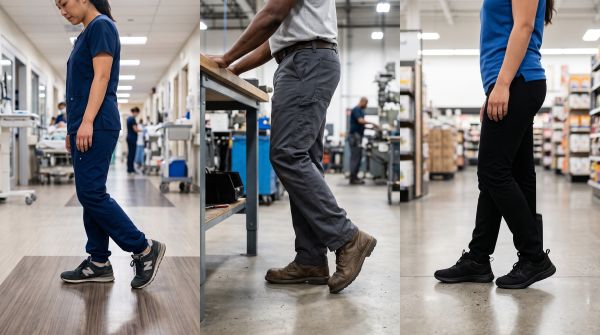
Shoes are just as important as the orthotics. For most standers, shoes should have removable insoles, adequate heel and midfoot depth, and a reasonably rigid sole so the orthotic doesn’t flex excessively. A wide, stable base and a firm heel counter provide the orthotic with a solid seat, which helps maintain alignment more consistently throughout the day.
For additional guidance on selecting comfortable work footwear, see these Alberta Health Services footwear recommendations, including advice on fit, width, heel height, and checking shoe comfort while standing and walking.
Compatible types differ per role. In trades and construction, safety or work boots that feature steel or composite toes, slip-resistant soles and at least mid-ankle height can go great with custom orthotics, provided the boot has a removable liner and sufficient volume. In retail or hospitality, cushioned sneakers or walking shoes with mesh uppers tend to fare better as they can withstand long shifts on unforgiving floors. In offices or client-facing roles, dress shoes with lower, wider heels, lace-up or strap closures and removable insoles are generally more orthotic-friendly than narrow loafers or high heels.
Quality arch support in the shoe still assists, even with orthotics. A stiff heel cup that doesn’t collapse controls rearfoot motion, reducing peak plantar pressures and hot spots under the heel and forefoot. Materials such as polyurethane or EVA in the midsole can distribute forces from impact and act in concert with the orthotic shell.
Rotating at least two or three pairs of supportive shoes will slow wear, make for better hygiene and allow your orthotics to dry completely between shifts. Slowly building up wear time, for example, beginning with two to three hours and progressively increasing over one to two weeks, tends to make the transition simpler for those who have never worn structured shoes before.
Movement Routines
Orthotics support alignment, but they don’t replace movement. Easy daily habits to relieve load on feet, calves, and lower back, particularly on concrete or tile floors. Short breaks to shift weight, flex the ankles, or sit for a minute help relieve constant pressure on the same areas.
Sample workplace‑friendly moves include:
-
Ankle circles in sitting or standing
-
Calf stretches against a wall or desk edge
-
Gentle toe curls inside the shoe
-
Marching in place for 30–60 seconds
-
Heel raises holding a stable surface
Even 2 to 3 minutes of walking every hour, in regular small walking bouts, helps blood flow, prevents stiffness, and makes standing less exhausting across a whole shift. Combining custom orthotics with mild compression socks can further encourage good circulation for those on their feet over 6 to 8 hours daily.
Tracking foot health adds a new dimension. Employees can record discomfort, swelling or numb areas at the beginning and end of their week, looking for correlations associated with specific activities or floors. Pinpointing daily activities and foot problems, such as prolonged static standing at a machine or repeated squatting, aids in customizing orthotic design and shoe selection to focus on the actual pressure points. Foot care specialists see patients regularly, particularly if they are in physically intense occupations, to identify early symptoms of overload and modify materials, like substituting a softer EVA top cover, before pain becomes a persistent problem.
Professional Care in Edmonton
Professional care in Edmonton for custom orthotics lives within this broader health ecosystem, with family physicians, physiotherapists, and foot specialists usually collaborating. Many Edmontonians already have positive experiences with local providers, particularly when care seems obvious, efficient, and relevant to their life at work or home.
Edmonton Foot Clinic is a local favorite among those who stand all day. Custom orthotics and footwear are available at the clinic, with fittings that center on comfort and support during long shifts, be it at a hospital ward, warehouse, school, or retail floor. Care is typically delivered by qualified clinicians with training in lower limb biomechanics and orthotic design; they examine not just the foot, but how the ankle, knee, and hip move together. While some clinics in Edmonton specialize in plantar fasciitis or diabetic foot concerns, this kind of targeted ability can be beneficial for anyone whose profession really puts a pounding on their feet.
The clinic’s process frequently begins with a comprehensive exam and gait analysis. This may involve observing your gait and stance, testing joint range of motion, and employing tools like 3D scans or pressure maps to analyze weight distribution on the foot. For instance, a teacher who reports burning under the ball of the foot may demonstrate high pressure under the second and third toes, whereas a nurse experiencing heel pain may exhibit sharp loading in the heel following prolonged static standing. These results then direct how custom orthotics are formed, from heel cup depth to arch height to the top cover selected to provide grip and breathability. Prices in Edmonton are typically somewhere between $595 and $649 CAD, which includes scanning, a biomechanical exam, lab fees, and the completed pair.
Continuing care is central to the clinic’s efforts. Patients are frequently requested to return for follow-ups so the team can monitor fit, comfort, and shifts in pain or fatigue. This is important for those who are on their feet all day, as minor adjustments such as trimming the forefoot, introducing a metatarsal pad, or cushioning a heel post can transform a “good” orthotic into one that feels second-nature during a 10-hour shift.
Edmonton professionals who observe persistent or increasing pain from standing, morning heel pain, midday burning arches, or sore knees after work can take that as a cue to shift from self-care to a complete evaluation. When conservative approaches are not enough for certain structural foot problems, a specialist may also discuss foot surgery procedures when appropriate.
Booking a visit with Edmonton Foot Clinic for podiatry services provides room for a systematic review of symptoms, work demands, and footwear. It can establish a clear plan that ties custom orthotics to easy actions like improved shoe selection and stretching.
Conclusion
All day standing takes a serious toll. Joints ache, feet blaze, and attention fizzles. That’s where custom orthotics come in to give you the support you need during that sort of day. They mold to your feet, distribute weight, and reduce stress in targeted areas such as the heel and balls of your feet.
For most of us, that translates to reduced pain at the end of a shift. Imagine a nurse doing a 12-hour ward shift or a retail worker during a hectic sale day. With the perfect fit in the shoe, every step becomes more grounded and more confident.
For next steps, consult with a foot care expert in Edmonton, have them answer the tough stuff, experiment with solutions, and monitor your foot comfort.
Frequently Asked Questions
How do custom orthotics help with prolonged standing?
Custom orthotics support your arches, align your feet and improve weight distribution. This minimizes wear and tear on ankles, knees, hips and lower back. They can mitigate aches and pains, stave off fatigue and help combat repetitive stress injuries from hours on your feet.
Are custom orthotics better than over-the-counter insoles for standing all day?
For minor pain, Dr. Scholls might do the trick. For chronic pain or long standing shifts, custom orthotics are generally better. They are built from a clinical evaluation of your feet, walking pattern and workplace requirements, which provides more targeted support.
What happens during a clinical evaluation for custom orthotics?
A clinician discusses your symptoms, work requirements and medical history. They study your feet, your posture and your gait. They might use pressure mapping or 3D scans. This then informs the design of custom orthotics for standing.
Can custom orthotics prevent work-related foot and leg pain?
They can greatly lessen the chance. By correcting foot mechanics and improving alignment, orthotics reduce stress on joints and soft tissues. Combined with appropriate footwear and activity breaks, they allow many workers to stand longer with less pain.
How long do custom orthotics for standing usually last?
Most custom orthotics last 2 to 5 years, depending on use and materials. Those who stand or walk multiple hours per day may burn through them faster. Regular checkups can help ensure they continue to fit well and offer proper support.
How can I integrate custom orthotics into my work routine?
Begin by wearing them a couple of hours a day, then work your way up. Wear them in supportive, well-fitting footwear. Pair orthotics with short breaks, stretching, and if available, anti-fatigue mats to make your comfort level as high as possible.
Where can I get professional custom orthotics if I work in Edmonton?
In Edmonton, custom orthotics are commonly provided by podiatrists, pedorthists, physiotherapists, and some chiropractors. Look for clinics that offer full assessments, gait analysis, and follow-up care. Checking reviews and professional credentials helps ensure qualified care.