
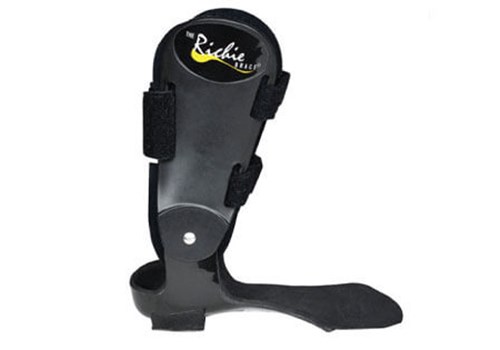
What Is An Ankle Brace For?
An ankle brace is a garment that is worn around the ankle to protect it and for immobilization while allowing it to heal from sprains or other injuries. Ankle braces are used to immobilize the joint while providing heat and compression to the bones. They are common in injury rehabilitation processes that affect the ankle.
In rehabilitation ankle braces are used to immobilize the ankle in a neutral position, which "theoretically minimizes stress at the repair site". Finally, are used in sports where the ankle is under stress, as in foot ball, soccer, tennis and other demanding sports where full ankle mobility is required.
Types Of Ankle Braces
There are a variety of Ankle Brace technologies check out our full selection of braces here: ANKLE BRACES
Step Ahead offers leading edge treatment approaches and clinical facilities to treat ankle issues as well as all other foot ailments.
Contact us for a consultation today!
Ankle Brace Frequently Asked Questions
Question:
Will wearing an ankle brace weaken my ankle?
Answer:
Most of our Richie Ankle braces have a hinge, so they allow full up and down natural range of motion necessary to enhance performance and keep the muscles strong.
Question:
Why should I wear a brace when I already have my ankles taped and supported?
Answer:
Tape will lose significant amount of support, in fact about about 70% of its support within the first half hour of activity, this is the same challenges with Like fabric lace-up ankle braces. If you tape your ankle joint, then start to any exercise the tape will immediately start to stretch and loosen.
Unlike taping, or fabric lace up, you can easily apply an ankle brace in seconds with no help. You don’t need another person, rolls of tape and pre-wrap, or scissors to cut it off later. And since our ankle braces have a hinge and move with the natural motion of your ankle joint, the brace stays firmly in place and secure maintaining lasting protection for hours.
Question:
Should ankle braces be worn while sleeping?
Answer:
No unless our podiatrists recommend you do so.
Question:
What is ankle unloading?
Answer:
Ankle unloading is related to individuals that have weight bearing pain from a recent injury or people with osteoarthritis. Ankle unloading is the ability of the ankle brace to absorb painful ankle impact from standing or walking that causes weight bearing pain. Or ankle braces are designed to provide the support you need.
How Durable Is The Richie Brace
Why Custom Versus Pre-made Ankle Braces
Before And After Treatment
Step Ahead Podiatry Is Committed To Helping You Gain The Freedom To Walk Pain Free Again...
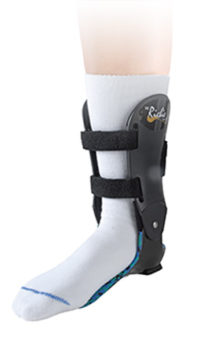
Richie Brace® Standard
FEATURES
- Custom balanced foot orthotic
- Standard 35mm heel cup fits into the bottom of the heel counter of the shoe
- Anatomic ankle axis hinge placement
- Semi-rigid lower limb supports
- Control of first ray, midtarsal, and subtalar joints
- Control of calcaneal inversion/eversion
- Pure, unrestricted sagittal ankle motion
CLINICAL INDICATIONS
- PTTD (mild-to-moderate)
- Lateral Ankle Instability
- Peroneal tendinopathy
- Cavo-varus deformity
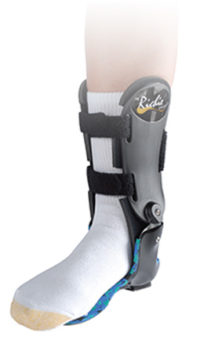
Richie Brace® Dynamic Assist
FEATURES
- Custom balanced foot orthotic
- 35mm heel cup
- Anatomic ankle axis hinge placement
- Tamarack flexural ankle joints
- Dynamic dorsiflexion-assist provides up to 15° of dorsiflexion
- Semi-rigid lower limb supports
- Control of varus/valgus alignment of the foot
- Pure, unrestricted sagittal ankle motion
CLINICAL INDICATIONS
- Dropfoot
- Peroneal Nerve Injury
- Post-CVA
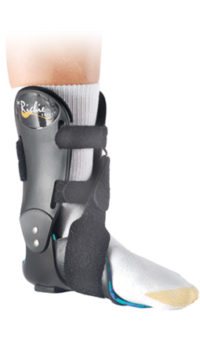
Richie Brace® with Arch Suspender
FEATURES
- Custom balanced foot orthotic
- Standard 35mm heel cup fits into the bottom of the heel counter of the shoe
- Anatomic ankle axis hinge placement
- Semi-rigid lower limb supports
- Control of first ray, midtarsal, and subtalar joints
- Control of calcaneal inversion/eversion
- Pure, unrestricted sagittal ankle motion
CLINICAL INDICATIONS
- PTTD (mild-to-moderate)
- Lateral Ankle Instability
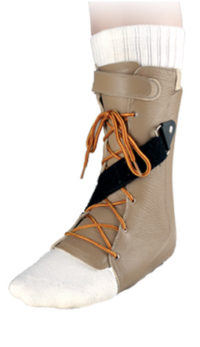
Richie Brace® Gauntlet
FEATURES
- Custom molded AFO shell
- Medial or Lateral Arch Suspender®
- Legitimate Varus/Valgus control of hindfoot
- Rearfoot stabilizing post
- Non-weight bearing cast provides better heel and arch contour
- All casts intrinsically balanced to correct forefoot varus/valgus deformities
CLINICAL INDICATIONS
- PTTD (stages III and IV)
- DJD (severe)
- Hindfoot Deformity
- Charcot Arthopathy
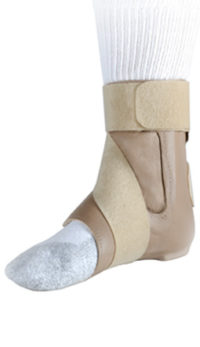
Richie Brace® California AFO
- Custom molded AFO shell
- Adjustable leather closure over tibia and forefoot
- Patented Medial or Lateral Arch Suspender®
- Rearfoot stabilizing post
- Continuous single strap closure, no laces
- Total restraint of foot and ankle movements
- Self-adjusting arch support
- Prevents medial/lateral instability
CLINICAL INDICATIONS
- PTTD (severe; stage IV)
- DJD (severe)
- Charcot Arthopathy
- Ankle Deformity
Not finding what you're looking for? Here are some of our most searched for podiatry services.
Additional Resources:
What is a Richie Brace used for?
The Richie Brace is a custom ankle-foot orthosis (AFO) designed to treat complex foot and ankle conditions by providing both support and controlled motion. It is commonly used for conditions such as posterior tibial tendon dysfunction (PTTD), chronic ankle instability, severe overpronation, drop foot, and degenerative joint disease. Unlike simple ankle braces, it combines a custom foot orthotic with semi-rigid lower leg uprights, helping to stabilize multiple joints at once. This makes it especially effective for patients who need stronger biomechanical control than standard insoles or braces can provide.
How does a Richie Brace help ankle instability?
A Richie Brace helps ankle instability by limiting excessive or uncontrolled ankle motion while still allowing functional walking mechanics. It stabilizes the subtalar, midtarsal, and ankle joints, preventing dangerous movements like inversion and eversion that often lead to repeated sprains. The brace redistributes forces across the foot and lower leg, reducing strain on weakened ligaments. This improved alignment helps patients regain confidence in walking and decreases the risk of re-injury, especially in chronic instability cases.
Can a Richie Brace treat flat feet effectively?
Yes, a Richie Brace can be very effective for treating flat feet, especially in moderate to severe cases where standard orthotics are not enough. It supports the collapsed arch by controlling excessive pronation and stabilizing the rearfoot and midfoot structures. This helps restore more natural alignment during walking and reduces pain in the arch, heel, and ankle. It is often used when flat feet are linked to posterior tibial tendon dysfunction or progressive deformity, where stronger mechanical support is required than typical insoles can provide.
Who needs an ankle-foot orthosis?
An ankle-foot orthosis (AFO), such as the Richie Brace, is typically needed by patients with significant instability, weakness, or structural deformity affecting foot and ankle function. Common candidates include individuals with chronic ankle sprains, tendon dysfunction, drop foot, arthritis, or severe flat feet. Athletes recovering from ligament injuries may also benefit in some cases. The purpose is to improve stability, reduce pain, and support safer walking mechanics when the natural musculoskeletal system cannot provide adequate control on its own.
Is the Richie Brace custom-made for each patient?
Yes, the Richie Brace is custom-made for each patient based on a detailed mold or scan of the foot and lower leg. This ensures precise fitting to the individual’s anatomy and specific biomechanical needs. Custom fabrication allows the brace to control abnormal motion while still fitting comfortably inside regular footwear. Adjustments can also be made depending on severity, activity level, and diagnosis, making it a highly personalized treatment option rather than a one-size-fits-all device.
How long should I wear a Richie Brace daily?
The duration of daily wear depends on the severity of the condition and the treatment plan prescribed by the podiatrist. Many patients are advised to wear the brace during all weight-bearing activities, especially walking or standing for long periods. In some cases, it may be worn throughout the day and removed at rest. Over time, some patients may reduce dependency as strength and stability improve, while others with chronic conditions may require long-term use for ongoing support.
Can braces replace surgery for ankle conditions?
In many cases, braces like the Richie Brace can delay or even help patients avoid surgery by improving stability, reducing pain, and correcting biomechanical stress. They are especially useful for chronic conditions such as tendon dysfunction or instability where conservative management is preferred first. However, they cannot reverse severe structural deformities or advanced joint damage. When conditions progress beyond bracing effectiveness, surgery may still be necessary. Bracing is often considered a strong non-surgical alternative or intermediate treatment step.
Are ankle braces comfortable for long-term use?
Modern custom ankle braces like the Richie Brace are designed for long-term comfort, using lightweight materials and a low-profile structure that fits inside most shoes. Many patients report improved mobility and reduced pain after adjustment. However, comfort depends on proper fitting and adaptation time, as the body adjusts to corrected biomechanics. Some initial stiffness or awareness of the device is normal. With proper customization and follow-up adjustments, long-term wear is generally well tolerated.
What conditions require ankle-foot orthotics?
Ankle-foot orthotics are used for a wide range of conditions involving instability, weakness, or structural imbalance. These include posterior tibial tendon dysfunction, chronic ankle instability, flat feet, drop foot, arthritis, and tendon injuries. They are also used after trauma or surgery to support healing and prevent re-injury. In more complex cases, they help control abnormal motion across multiple joints, improving walking efficiency and reducing long-term strain on the lower limbs.
Can athletes use Richie Braces during activity?
Yes, athletes can use Richie Braces during training and sometimes even during competition, depending on the sport and severity of the condition. The brace is designed to fit inside athletic footwear while providing stability without overly restricting movement. It is often used by athletes recovering from ankle injuries or dealing with chronic instability to prevent re-injury. Supporting proper alignment and limiting harmful motion, it helps maintain performance while protecting vulnerable joints during high-impact activity.